


Fume Cupboards For Schools
Fume cupboards for schools are often used within laboratories with the aim of containing hazardous chemicals and preventing their release into the classroom environment.
Description
What is Fume Cupboards For Schools
Fume cupboards for schools are often used within laboratories with the aim of containing hazardous chemicals and preventing their release into the classroom environment.
Benefit 1: Fume cupboards for schools are movable
As the name suggests, fume cupboards for schools are movable. They can be shared among various projects at different times ofportable fume hood the day or on different days of the week.
Many ductless fume hoods are on wheels, making it easy to position them when and where needed, including when they are not in service. This level of mobility is impossible with ducted fume hoods, which are permanently connected to your hvac system.
Benefit 2: Fume cupboards for schools are less expensive
The initial cost of a portable fume hood is almost always less than the cost of a ducted unit. That's because fume cupboards for schools don't require the extensive ductwork and structural modifications that ducted fume hoods need. Ducted fume hoods often need significant changes to the building's hvac system to ensure proper ventilation as well. This can be costly. Because fume cupboards for schools are self contained, they don't require these modifications.
The day-to-day operational costs of fume cupboards for schools can be lower than ducted hoods as well. Since a portable unit only uses energy when it's in use, you may save energy costs. Ducted fume hoods also need to push air over longer distances, which consumes energy.
Benefit 3: Portable units are easier to install
For many of the same reasons outlined above, portable units are easier to install. In fact, a ductless fume hood is often ready to go immediately after delivery. Workers simply insert the appropriate hepa filter or carbon filter, roll it to the workstation and plug it in.
Contrast this with ducted fume hoods, which require more complex connections and may require licenses, permits and approvals before operating for the first time. Building engineers may require training to ensure proper maintenance of ducted fume hoods as well, while lab workers can typically maintain portable models.
Benefit 4: Fume cupboards for schools allow for scalability
Fume cupboards for schools offer significant scalability advantages for lab operations, making it easier to adjust to varyingportable fume hood business demands and project scopes.
When expanding your lab, adding fume cupboards for schools can be done quickly and without the need for extensive renovations or infrastructure upgrades. This allows for rapid scaling to accommodate increased workloads or new types of research and development activities.
If there is a need to downsize or reconfigure the lab, fume cupboards for schools can be relocated, repurposed or stored with minimal effort and expense. This flexibility helps you optimize space and ensures that resources aren't wasted on permanently installed equipment that may not always be in use.

General Use: Commercial Furniture
Type: Laboratory Furniture, Laboratory Furniture
Mail packing: N
Application: Hospital, School, Other
Design Style: Modern

General Use: Commercial Furniture
Type: Laboratory Furniture
Material: Metal
Metal Type: Iron
Place of Origin: Jiangsu, China

General Use: Commercial Furniture
Type: Laboratory Furniture
Material: Metal
Metal Type: Iron
Place of Origin: Jiangsu, China

STRUCTURE: C frame/ H frame/ Pedestal/ Free standing
SIZE: Wall Bench:L*750*850mm/ Island Bench:L*1500*850mm, can be customized
COLOR: Optional
HANDLE: stainless steel handle/ aluminum alloy handle
HINGE: DTC 175 degree open type hinge/ stainless steel hinge

Specific Use: School Sets
General Use: Commercial Furniture
Type: School Furniture
Mail packing: N
Application: School

General Use: Commercial Furniture
Type: Laboratory Furniture
Mail packing: N
Application: Home Office, Living Room, Hotel, Office Building, Hospital, School, Other, Hall
Design Style: Modern

STRUCTURE: C frame/ H frame/ Pedestal/ Free standing
SIZE: Wall Bench: L*750*850mm/ Island Bench: L*1500*850mm, can be customized
COLOR: Optional
HANDLE: stainless steel handle/ aluminum alloy handle
HINGE: DTC 175 degree open type hinge/ stainless steel hinge

Fume Chamber In Chemistry Laboratory
General Use: Commercial Furniture
Type: Laboratory Furniture
Mail packing: N
Application: Home Office, Living Room, Hotel, Office Building, Hospital, School, Other, Hall
Design Style: Modern

STRUCTURE: C frame/ H frame/ Pedestal/ Free standing
SIZE: Wall Bench: L*750*850mm/ Island Bench:L*1500*850mm, can be customized
COLOR: Optional
HANDLE: stainless steel handle/ aluminum alloy handle
HINGE: DTC 175 degree open type hinge/ stainless steel hinge
Why Choose us
Quality Assurance
We have mechanical and electrical installation, decoration and laboratory furniture sales, all of which have passed the ISO9001 quality management system certification, ISO14001 environment management system certification and OHSAS18001 occupational health and safety management system certification.
Quality services
Our team is committed to delivering high-quality services to our clients. We use the latest technologies and tools to ensure that our services exceed your expectations.
Experience and expertise
Our company has been in business for many years and has amassed significant expertise and experience to provide quality services to our clients.
Types of Fume Cupboards For Schools
A bench-top fume hood is a hood that sits on a work surface approximately 36" above the floor. Along with the hood, you will need a supporting base cabinet, a work surface, and an exhaust blower.
A floor-mounted fume hood, or a walk-in fume hood, is installed from the floor up instead of sitting on another surface.
It resembles a small room, allowing you to work inside the space. This is ideal when you may need to use oversized tools or equipment, such as drums, processing units or robots while working with toxic chemicals. The large doors allow you to roll large apparatus or tables into the area as needed. These fume hoods can range in size depending on your needs but are generally the size of a small closet. Standard models range from 6 to 24 feet wide, 7 to 16 feet high, and 4 to 8 feet deep. However, these can be custom-made to fit your desired dimensions.
A double-faced fume hood is most ideal for demonstrations. It has entrances on both sides and allows for 360-degree viewing. This type of fume-hood can come as a typical bench-top or wall installation or as a portable unit. These are usually in classrooms or laboratories where teaching demonstrations are frequent.
Portable double-faced fume hoods are especially useful in shared learning environments, where the hood may need to be moved from one classroom to the next.
Portable fume hoods are also known as recirculating range hoods. They are ductless, which means that they operate off of a carbon filter system.
These hoods are cheaper, easier to install, mobile, and use less energy. The installation process requires no ductwork or wall penetration. They're usually smaller or on wheels, so you're able to move them to different areas of your lab. If energy-usage is important, these are eco-friendly when compared to the energy usage of full-sized fume hoods.
While portable fume hoods may seem like an easier option, there are a few disadvantages to this model. The method in which toxins filter out can put workers at a higher risk of exposure. Filters also need regular maintenance.
Different uses for Fume Cupboards For Schools

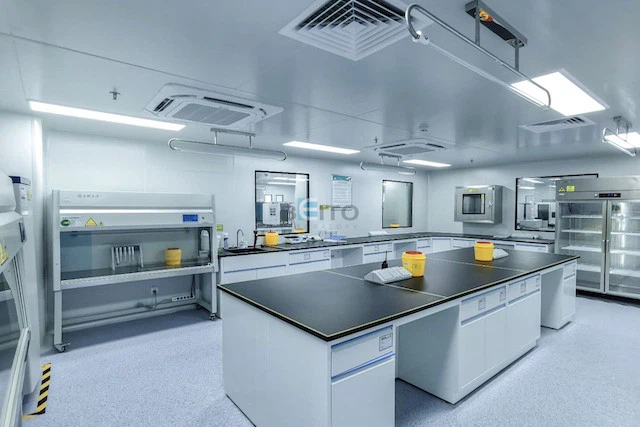
Education science labs
Our first effective use of fume cabinets is to give school, college and university students a safe space to perform experiments. These could be mixing chemicals, pouring liquids into test tubes, or actions like stirring, mixing and weighing. Whatever they're being used for, our fume cabinets are designed to keep students safe from potentially harmful vapours and particulates.
Military weapons development
Another of our different uses for fume cabinets is one that may surprise you. One of our customers creates defence systems and uses their fume cabinet to analyse explosives. The cabinet we provided them is a high-end, explosion-proof unit, which really does show just how bespoke our fume cabinet solutions can be.
Medical and dental research laboratories
Medical research (including the dental offshoot) is one of the more well-known examples of general applications for ductless fume cabinets and ducted fume hoods. Being specific, the cabinet could be used in the creation of vaccines or antibiotic medicines, allowing researchers to perform experiments without fear of breathing in potentially harmful particulates.
Automotive and aerospace research
Automotive and aerospace manufacturing are both ripe with reasons to use fume cupboards. From fuel synthesis to plasticiser research and the application of industrial-strength glues, the different safe uses of fume cabinets in this industry are many and varied.
Electronics manufacturing
If making enormous vehicles wasn't enough, fume hoods can also be used in the creation of something as humble as soldering a simple table lamp. Used correctly, a suitable fume cupboard will offer effective protection against breathing in harmful solder fumes.
The placement of the fume cupboards for schools is an important factor to consider. Since airflow containment devices are sensitive to airflow disruptions, a bad location may affect the overall performance of the unit. Here are some guidelines on how to properly install your fume cupboards for schools.
Environmental requirements
For indoor use only
Altitudes of up to 2,000 meters
20%-90% relative humidity
Temperature between 18°c-30°c
Note: It is recommended that the temperature in the laboratory be maintained within a ±2°c range under all conditions.
Location requirements
When installing the fume cupboards for schools, it should be located as far away as possible from sources of airflow disturbances and in an orientation which optimally shields the fume cupboards for schools's airflow from all external airflow disturbances.
The fume cupboards for schools should be installed away from any kind of heat sources (heaters, fan converters, etc.) to facilitate an optimum operating condition.
An adequate space of at least 30 cm must be left on the back and sides of the unit for easy cleaning.
Position requirements
Any pedestrian routes or walkways should be at least 1.0 m from the front of the fume cupboards for schools.
If there are opposing fume cupboards for schoolss, the distance from the aperture should be more than 3 m.
Obstructions such as pillars or columns in the laboratory should not be within 30 cm of the sides of the fume cupboards for schools.
If there are opposing walls or obstructions, the fume cupboards for schools should be placed at least 2m away to avoid airflow disruption.
Exhaust requirements
For ductless fume cupboards for schoolss, clearance of at least 30 cm is recommended between the highest point of the cabinet and ceiling.
For ducted fume cupboards for schools, make sure that the ducting is leak tight and is resistant with the chemicals being handled.
For easier service, a minimum clearance of 50 cm is recommended.
Best Practices in Fume Cupboards For Schools Usage
Mind the sash: Practice closing the sash as much as possible while using the hood ‒ you never know when something may go wrong with your experiment. Make sure you know how to operate the sash completely and quickly. Never heat something in the hood without first closing the sash. On no accounts, ever, put anything in the hood that prevents the sash from closing completely.
Don't lean on it: It should be a no-brainer, but you'll be surprised how many people working in a lab have a shortage of brains. Do not lean on expensive safety equipment ‒ how much simpler can it be? If you're tired, sit down!
No head in the oven: You don't put your head inside an oven, do you? Please don't do it here either ‒ keep your head (and other body parts, as much as possible) outside the fume cupboards for schools. Again, it should be a no-brainer, but when manufacturers have to mention this specifically in the manual, you know what the world is coming to.
Practice turning things off: You know the old saying ‒ the real wisdom is knowing when to stop? The same goes here. Practice turning all the knobs and switches off. Regularly.
Use monitors: Keep checking the airflow, temperature, toxicity, etc. with appropriate measurement tools while you use the hood. It may mean the difference between life and death.
Use a ribbon: Tape a small piece of a brightly colored ribbon to the inside of the sash and keep an eye on that to be aware of the airflow instantly.
Keep outside air still: Keep the fume cupboards for schools in an area where there are no drafts of air ‒ naturally or artificially ‒ especially when using the hood. This may intervene with the normal airflow of the hood and create cross-drafts that cause leakage in the wrong direction.
15 centimeters: Keep your experiment apparatus and glassware at least 15 cm away from the sash.
Have a plan B: What if the main power goes off when you're in the middle of a particularly nasty experiment in the fume cupboards for schools? Make sure you have a safety plan ready for such situations.
Company Introduction
Beito Laboratory Equipment Co., Ltd. is a laboratory furniture and laboratory equipment manufacturer integrating R & D, design, manufacturing and sales.
We have a steel wood and PP workshop covering an area of 3000m2, a steel workshop covering an area of 3500 m2, and a complete set of spraying assembly lines. It is a large-scale laboratory equipment manufacturing enterprise in China,focusing on the field of high-end laboratory engineering.

Our Certificate
We have mechanical and electrical installation, decoration and laboratory furniture sales, all of which have passed the ISO9001 quality management system certification, ISO14001 environment management system certification and OHSAS18001 occupational health and safety management system certification.

Asked Questions
Q: What Can A Fume Cupboards For Schools Be Used For?
Recirculating Cupboards mounted on a benchtop are suitable for use in numerous situations where external extraction is impractical, but contaminant capture and filtration is necessary. This includes the filtration of fumes, vapour and particulates emanating from: Monomers, adhesives, hazardous powders/particulates, conformal coatings, resins, sealants, solders, light grinding particles, dusts and organic solvents.
Fume Cupboards For Schoolss should be used only for laboratory applications and not as storage areas. Using a Fume Cupboards For Schools for storage will interfere with the air flow within the working area and increases the chance that harmful substances being released into the lab/classroom environment. If there were an accident, the presence of stored chemicals in the cupboard would increase the risks.
Nobody should carry out an experiment or technology work in a Fume Cupboards For Schools that is being used as a store.
Q: How Do I Keep My Fume Cupboards For Schools Maintenance Up To Date?
It's a legal requirement that all Fume Cupboards For Schoolss are maintained and that their performance is measured at least every 12 months. A member of staff in the workplace should be responsible for ensuring that:
Fume Cupboards For Schoolss in the School / University are inspected and maintained.
Records are kept of inspection and maintenance and certificates provided by maintenance contractors are kept on file.
Face velocities are marked on the cupboards.
Any Fume Cupboards For Schools which is not inspected or fails its inspection must be condemned or repaired.
Q: What are the ventilation requirements for fume cupboards for schools?
Q: How often should fume cupboards for schools be tested?
Q: What are the key factors that will affect the effectiveness of a fume cupboards for schools?
Objects obstructing the return ducts and baffle areas. ...
Objects and equipment too close to the front of the fume hood. ...
Secondary currents created by portable fans and traffic in front of the hood.
Q: How do you maintain a fume cupboards for schools?
Q: Which of the following must you check before using a fume cupboards for schools?
Q: What safety things should you check before you use a fume cupboards for schools?
Q: Is a fume cupboards for schools PPE?
Q: What should be carried out in a fume cupboards for schools?
Q: How often should fume cupboards for schoolss be checked?
Q: What are the principles of fume cupboards for schools?
Q: What should you do first when starting any work in a fume cupboards for schools?
Q: What three things should you check before using a fume cupboards for schools?
Q: What are the safety guidelines for fume cupboards for schoolss?
Conduct all work and keep all apparatus at least 6 inches back from the face of the hood. ...
Keep the hood sash closed as much as possible.
Keep the hood slots and baffles free of obstruction by apparatus or containers.
Do not permanently store apparatus or chemicals in the hood.
Q: Do fume cupboards for schoolss need to be inspected?
Q: What is the difference between a fume cupboards for schools and a biosafety hood?
Q: How do you test the functionality of a fume cupboards for schools?
Q: What is the minimum face velocity for a fume cupboards for schools?
Q: How to test a fume cupboards for schools?
Hot Tags: fume cupboards for schools, China fume cupboards for schools manufacturers, suppliers, factory, Modular Lab Benches, Portable Fumehood, Fume Hood Design, Fume Hood, Fume Hood Exhaust Fan


