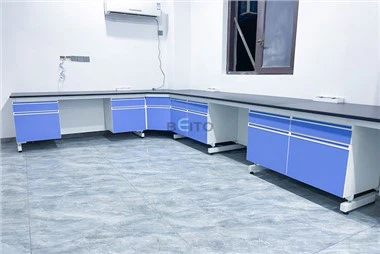

Wooden Lab Bench
Wooden casework furniture are one of the most common types of furniture found in any laboratory and for good reason. They're durable, sturdy, and don't bruise easily. It makes it perfect for any laboratory that could go through excessive customization in the future or deals with harsh chemicals regularly.
Description
What is Wooden Lab Bench
Wooden casework furniture are one of the most common types of furniture found in any laboratory and for good reason. They're durable, sturdy, and don't bruise easily. It makes it perfect for any laboratory that could go through excessive customization in the future or deals with harsh chemicals regularly.
Benefits of Wooden Lab Bench
Durability
Wooden lab benches are quite durable and resistant to wear and tear. They can withstand heavy loads and consistent use for several years.
Aesthetics
Wooden lab benches look pleasing to the eye and can provide a classic and traditional look to the lab.
Stain resistance
Some types of wood, such as oak, have natural stain resistance, providing an added layer of protection for the lab.
Chemical resistance
Certain types of wood, such as teak, are not affected by most laboratory chemicals.


Why Choose Us
State-of-the-art Technology
We use the latest technology and tools to deliver high quality services. Our team is well-versed in the latest trends and advancements in technology and uses them to provide the best results.
Competitive Pricing
We offer competitive pricing for our services without compromising on quality. Our prices are transparent, and we do not believe in hidden charges or fees.
Customer Satisfaction
We are committed to delivering high quality services that exceed our clients' expectations. We strive to ensure that our clients are satisfied with our services and work closely with them to ensure their needs are met.
One-stop service
We promise to provide you with the fastest reply, the best price, the best quality, and the most complete after-sales service.
Application of Wooden Lab Bench Storage
Use as a work surface
Wooden lab benches provide a stable and level surface for experiments, research, and testing. They are durable and can withstand most chemical spills and splashes.
Storage for lab instruments
With the multiple drawers, cabinets, and shelves, wooden lab bench storage offers ample space to store equipment and materials. This keeps them organized and easily accessible.
Holders for lab samples
Wooden lab benches with pegboards or hooks can be used for hanging lab samples. This reduces the risk of contamination, ensures proper labeling, and makes it easier to access and retrieve samples.
Use as a display space
Wooden lab bench storage can be useful for displaying finished experiments or prototypes. This allows for observation and study by other researchers or scientists.
As a teaching tool
Wooden lab benches can be used as a visual aid for teaching students in science classes. It can also be an instrument for conducting experiments and visual demonstrations.
As a tool storage and organizational aid
A wooden lab bench can be used as a space to store and organize lab tools and supplies like scalpels, forceps, and beakers.
Difference Between Metal And Wood For Laboratory Benches
Both metal and wood are popular materials but have distinct advantages and disadvantages.
Here is a comparison of metal and wood for lab benches.

Durability and Strength
1. Wood: Hardwoods, like maple or oak, are often used for wooden laboratory benches and cabinets. These types of wood are sturdy, long-lasting, and can handle the weight of heavy equipment. However, wood can be vulnerable to moisture, chemicals, and pests, which might reduce its lifespan in specific lab environments.
2. Metal: Typically made from stainless steel or other alloys, metal lab benches are known for their resistance to chemicals, heat, and general wear and tear. They can last years without significant degradation, especially in settings with heavy chemical usage.

Maintenance and Cleanliness
1. Wood: Wooden benches require periodic sealing to protect against moisture and chemicals. It is essential to sterilise spills immediately to prevent staining or damage. Disinfecting wood can be more challenging due to its porous nature.
2. Metal: Metal benches are easier to clean and disinfect. They are non-porous, which means they do not absorb spills and can resist stains. Simple wiping with appropriate cleaning agents is usually sufficient.
Aesthetics and Ambiance
History of Technology on Lab Furniture
The development of laboratory furniture has improved leaps and bounds thanks to new advances in technology and methods of construction. At the time where scientific curiosity and experimentation began, there were scarce to no signs of laboratory furniture production. Experimental tools were created by each individual scientist for his own work. By the end of this century, science instruments began being produced on a small scale, and scientist turned their reliance to this market, instead of their own developments. Most of the tools were made of wood, and some were made of metal.
At the turn of 17th century, the industrial revolution came upon us full steam ahead. Technologies of all kinds were developing, including laboratory equipment. This is where we see the first laboratory worktops being developed, all of which were made of wood. By the end of the 20th century, stainless steel lab furniture began to make its debut during the Vietnam War. Steel tables and worktops quickly overruled those made of wood, because wooden furniture was easily damaged and would rot, due to the climate.
Presently, these tools are incomparable to the earliest versions, and with the progress made in only a couple centuries, it is unfathomable where we will be in the future. Advances in technology and materials have taken laboratory furniture to a whole new level of safety, strength, appearance, productivity, and durability which has then furthered the advancement of those discoveries made within the lab.
Lab benches have more storage than many other benches as they are specially designed to help keep lab spaces clutter-free. Benches like park benches and industrial workbenches may not have as much storage space as they're primarily used for sitting and component assembly and repair.
Storage is always a struggle for laboratories. Lab technicians tend to be more productive in well-organized spaces than in cluttered ones. Organization helps promotes efficient testing and experimentation. They're also likely to be safer as the risk of tripping and falling in a well-organized space is almost non-existent.
Offers benches with in-built storage spaces to boost laboratory efficiency and safety. Our benches contain drawers, shelves, and cabinets you can use to store items like chemicals, waste containers, and experiment equipment, leaving you with enough space on which to work.
Some also contain pump enclosures featuring sound suppression foam, dense wood, and anti-vibration mounts to reduce pump noise-they can reduce between 13-19dB of noise. Our storage solutions are flexible, so you can reconfigure them as your laboratory needs change without purchasing entirely new benches.

Wooden lab benches have a variety of applications in laboratory settings. While they may not be as common as benches made from other materials like stainless steel or phenolic resin, wooden lab benches offer unique advantages and are suitable for specific applications. Here are some common applications of wooden lab benches:
Educational Laboratories
Wooden lab benches are often used in educational institutions, such as schools and universities, for teaching and training purposes. They provide a practical and cost-effective solution for introductory science labs or classrooms where basic experiments and demonstrations are conducted.
Research and Development
Wooden lab benches can be used in research and development laboratories, particularly in fields where chemical resistance is not a primary concern. They provide a stable and durable surface for conducting experiments, setting up equipment, and performing non-hazardous tasks.
Microbiology and Biotechnology
Wooden lab benches can be suitable for certain microbiology and biotechnology applications, such as microbial culture work or non-chemical-based experiments. They can provide a warm and natural surface that is less likely to damage delicate samples or cultures.
Art Conservation and Restoration
Wooden lab benches are commonly used in art conservation and restoration studios. They provide a stable and non-reactive surface for working on delicate artworks, sculptures, or artifacts. The natural aesthetics of wood can also be preferred in these settings.
Non-Hazardous Testing
Wooden lab benches can be used for non-hazardous testing or analysis, such as physical testing, sample preparation, or basic measurements. They can provide a comfortable and functional workspace for these types of activities.
The Considerations for Buying Wooden Lab Bench
Material Quality
Choose a wooden lab bench made from high-quality materials that are durable and resistant to wear and tear. Look for benches made from solid hardwood or plywood with a sturdy construction. The wood should be treated or coated to enhance its durability and resistance to moisture, chemicals, and stains.
Size and Configuration
Consider the size and configuration of the lab bench to ensure it fits within your workspace and meets your specific requirements. Determine the dimensions of the bench, including the length, width, and height, and ensure it provides enough workspace for your tasks. Consider the number and placement of drawers, shelves, or other storage options based on your storage needs.
Chemical Resistance
Assess the chemical resistance of the wooden lab bench to ensure it can withstand exposure to common laboratory chemicals. While wood is generally not as chemically resistant as other materials like stainless steel or phenolic resin, certain treatments or coatings can enhance its resistance. Look for benches with chemical-resistant finishes or consider adding a protective coating if necessary.
Ergonomics and Comfort
Consider the ergonomics and comfort of the lab bench to ensure a comfortable and efficient working environment. Look for benches with adjustable height options to accommodate different users and tasks. Consider the placement of accessories like footrests or armrests for added comfort during long hours of work.
Stability and Load Capacity
Ensure that the wooden lab bench is stable and has a sufficient load capacity to support your equipment and materials. Look for benches with sturdy construction, reinforced legs, and proper weight distribution. Consider the weight capacity of the bench and ensure it can support the weight of your equipment and samples.
Safety Features
Look for safety features in the wooden lab bench to ensure a safe working environment. This may include features like rounded edges to prevent injuries, non-slip surfaces, or built-in safety mechanisms. Consider any additional safety requirements specific to your laboratory and ensure that the bench meets those requirements.
Maintenance and Cleaning
Consider the ease of maintenance and cleaning of the wooden lab bench. Look for benches with smooth surfaces that are easy to wipe clean. Consider the type of finish or coating used on the wood and ensure it is resistant to stains and easy to maintain. Follow the manufacturer's guidelines for cleaning and maintenance to prolong the lifespan of the bench.
Budget
Set a budget for your wooden lab bench and consider the cost in relation to the quality and features offered. While it is important to stay within budget, prioritize quality and functionality to ensure a reliable and durable bench.
Supplier Support and Warranty
Choose a reputable supplier or manufacturer that offers good customer support and warranty for their wooden lab benches. This ensures that you can get assistance when needed and have peace of mind knowing that the bench is backed by a reliable warranty.
Our Factory
Beito Laboratory Equipment Co., Ltd. is a laboratory furniture and laboratory equipment manufacturer integrating R & D, design, manufacturing and sales.
We have a steel wood and PP workshop covering an area of 3000m2, a steel workshop covering an area of 3500 m2, and a complete set of spraying assembly lines. It is a large-scale laboratory equipment manufacturing enterprise in China,focusing on the field of high-end laboratory engineering.

Our Certificate
We have mechanical and electrical installation, decoration and laboratory furniture sales, all of which have passed the ISO9001 quality management system certification, ISO14001 environment management system certification and OHSAS18001 occupational health and safety management system certification. The above personnel and qualifications ensure the company's ability to deliver domestic leading and world-class laboratories to customers.

FAQ
Hot Tags: wooden lab bench, China wooden lab bench manufacturers, suppliers, factory, Laboratory Instrument Table, Modular Lab Benches, Mobile Laboratory Benches, Stainless Steel Laboratory Table, Lab Bench with Sink, Bench in Lab