

What are the magnetic susceptibility properties of laboratory benchtops?
Aug 19, 2025
Magnetic susceptibility is a crucial property when it comes to laboratory benchtops. As a leading supplier of laboratory benchtops, we understand the significance of this characteristic in various laboratory settings. In this blog, we will explore the magnetic susceptibility properties of laboratory benchtops, their implications, and how they can impact your laboratory operations.
Understanding Magnetic Susceptibility
Magnetic susceptibility, denoted by the symbol χ (chi), is a measure of how much a material will become magnetized in an applied magnetic field. It is a dimensionless quantity that indicates the degree of magnetization of a material in response to an external magnetic field. Materials can be classified into three main categories based on their magnetic susceptibility: diamagnetic, paramagnetic, and ferromagnetic.
- Diamagnetic Materials: These materials have a negative magnetic susceptibility, meaning they are weakly repelled by a magnetic field. Examples of diamagnetic materials include copper, silver, and water. Diamagnetic materials do not retain any magnetization once the external magnetic field is removed.
- Paramagnetic Materials: Paramagnetic materials have a positive magnetic susceptibility, indicating that they are weakly attracted to a magnetic field. These materials contain unpaired electrons, which align with the external magnetic field. Examples of paramagnetic materials include aluminum, oxygen, and platinum. Like diamagnetic materials, paramagnetic materials lose their magnetization when the external magnetic field is removed.
- Ferromagnetic Materials: Ferromagnetic materials have a very high positive magnetic susceptibility and can be strongly magnetized. They contain magnetic domains that can align with an external magnetic field, resulting in a large net magnetization. Examples of ferromagnetic materials include iron, nickel, and cobalt. Ferromagnetic materials can retain their magnetization even after the external magnetic field is removed, making them useful for applications such as magnets and magnetic storage devices.
Magnetic Susceptibility in Laboratory Benchtops
The magnetic susceptibility of laboratory benchtops can have significant implications for laboratory experiments and equipment. Here are some key considerations:
- Interference with Magnetic Instruments: In laboratories where magnetic instruments such as nuclear magnetic resonance (NMR) spectrometers, magnetic resonance imaging (MRI) machines, or superconducting quantum interference devices (SQUIDs) are used, the magnetic susceptibility of the benchtop can cause interference. Even small magnetic fields generated by the benchtop can affect the accuracy and performance of these sensitive instruments. Therefore, it is essential to choose benchtops with low magnetic susceptibility to minimize interference.
- Sample Manipulation: Magnetic susceptibility can also affect the manipulation of magnetic samples in the laboratory. For example, in magnetic separation techniques, where magnetic particles are used to separate target molecules or cells from a sample, the magnetic properties of the benchtop can influence the efficiency of the separation process. A benchtop with high magnetic susceptibility may attract or interfere with the magnetic particles, leading to inaccurate results.
- Electromagnetic Compatibility (EMC): In modern laboratories, electromagnetic compatibility is a critical concern. The magnetic susceptibility of benchtops can contribute to electromagnetic interference (EMI) and radio frequency interference (RFI), which can disrupt the operation of electronic equipment and communication systems. By choosing benchtops with low magnetic susceptibility, you can help ensure the EMC of your laboratory environment.
Types of Laboratory Benchtops and Their Magnetic Susceptibility
There are several types of laboratory benchtops available on the market, each with its own magnetic susceptibility properties. Here are some common types of benchtops and their characteristics:
- Wood Laboratory Tables: Wood Laboratory Tables are a popular choice for many laboratories due to their natural beauty, durability, and affordability. Wood is generally considered a diamagnetic material, which means it has a low magnetic susceptibility. However, the magnetic susceptibility of wood can vary depending on the type of wood and its moisture content. In general, hardwoods such as oak and maple have lower magnetic susceptibility than softwoods such as pine and cedar.
- Laboratory Instrument Table: Laboratory Instrument Table are designed to provide a stable and level surface for sensitive laboratory instruments. These tables are often made of materials such as stainless steel, aluminum, or composite materials. Stainless steel is a paramagnetic material, which means it has a low positive magnetic susceptibility. Aluminum is also a paramagnetic material, but it has a lower magnetic susceptibility than stainless steel. Composite materials, such as epoxy resin or phenolic resin, can have a wide range of magnetic susceptibility depending on their composition.
- Medical Lab Tables: Medical Lab Tables are used in medical laboratories for a variety of applications, including sample preparation, analysis, and diagnosis. These tables need to be clean, durable, and resistant to chemicals and stains. Medical lab tables are often made of materials such as stainless steel, plastic laminate, or epoxy resin. Stainless steel and plastic laminate are both paramagnetic materials, while epoxy resin can have a low magnetic susceptibility depending on its formulation.
Choosing the Right Laboratory Benchtop Based on Magnetic Susceptibility
When choosing a laboratory benchtop, it is important to consider the magnetic susceptibility requirements of your laboratory. Here are some factors to keep in mind:

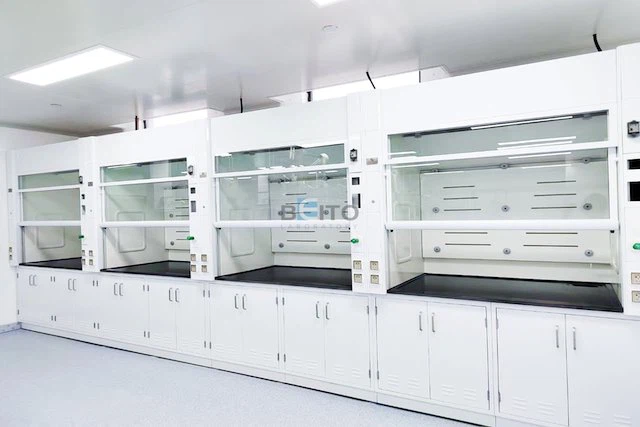
- Type of Experiments and Equipment: Consider the types of experiments and equipment you will be using in your laboratory. If you are using magnetic instruments or working with magnetic samples, you will need a benchtop with low magnetic susceptibility to minimize interference.
- Budget: The cost of laboratory benchtops can vary depending on the material, size, and features. While benchtops with low magnetic susceptibility may be more expensive, they can provide long-term benefits in terms of accuracy and performance.
- Maintenance and Durability: Choose a benchtop that is easy to clean and maintain. Benchtops made of materials such as stainless steel or epoxy resin are generally more durable and resistant to chemicals and stains than wood or plastic laminate benchtops.
- Customization Options: Some laboratory benchtop suppliers offer customization options, such as the ability to choose the material, color, and size of the benchtop. This can allow you to tailor the benchtop to your specific needs and requirements.
Conclusion
Magnetic susceptibility is an important property to consider when choosing a laboratory benchtop. By understanding the magnetic susceptibility properties of different materials and their implications for laboratory experiments and equipment, you can make an informed decision about the type of benchtop that is best suited for your laboratory. As a Laboratory Benchtop supplier, we offer a wide range of benchtops with low magnetic susceptibility to meet the needs of various laboratory applications. If you have any questions or would like to discuss your laboratory benchtop requirements, please contact us to start a procurement discussion.
References
- Cullity, B. D., & Graham, C. D. (2008). Introduction to Magnetic Materials. Wiley-IEEE Press.
- Kittel, C. (2005). Introduction to Solid State Physics. Wiley.
- O’Handley, R. C. (2000). Modern Magnetic Materials: Principles and Applications. Wiley.